
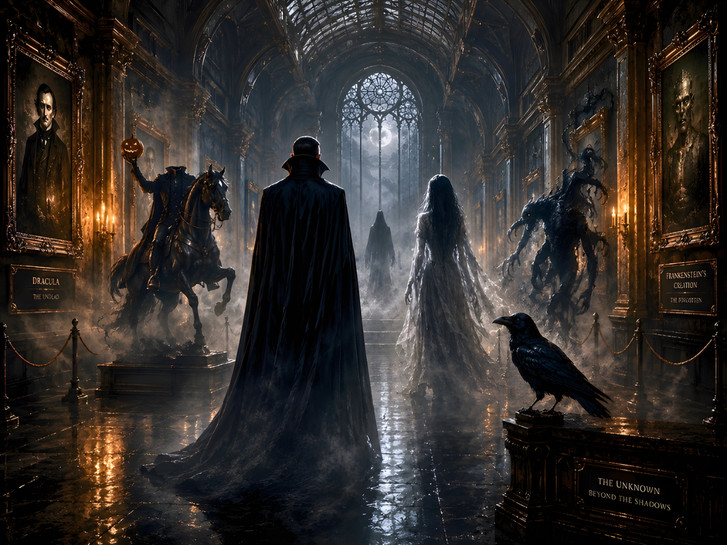
Why We Remember Monsters
Most stories fade.
A book may become a bestseller, a movie may dominate the box office, and a character may briefly capture public attention. Yet as years pass, many of those stories quietly disappear from popular memory.
Some characters, however, refuse to leave.
Generation after generation, certain figures continue to return. New audiences discover them. Artists reinterpret them. Writers revisit them. Their appearances change, but their presence remains.
Dracula is one of them.
The Headless Horseman is another.
Frankenstein's creation still walks through popular culture more than two centuries after Mary Shelley first imagined him.
Why?
The answer has less to do with horror than many people realize.
Great monsters survive because they become symbols.
They stop belonging entirely to a single story and begin representing something larger. Fear, mystery, temptation, loneliness, obsession, transformation, and the unknown all find expression through the monsters we create.
That is why folklore endures.
Long before film studios and special effects existed, people gathered around fires and shared stories. The details changed from one generation to the next, but the underlying ideas remained recognizable. Every culture created figures that embodied its fears, warnings, hopes, and mysteries.
The monster became a storyteller.
In many ways, modern horror continues the same tradition.
The monsters we remember are rarely the ones that simply frightened us. They are the ones that fascinated us. They made us wonder what lived beyond the edge of the forest, behind a locked door, or within the shadows of an unfamiliar room.
Fear may capture attention.
Curiosity creates memory.
That distinction helps explain why some horror icons continue to thrive while countless others are forgotten.
The most enduring figures invite interpretation. Each generation discovers something different within them. A vampire may represent temptation in one era and isolation in another. A ghost story may become a reflection on grief. A folklore legend may transform into a symbol of cultural identity.
The stories evolve because people evolve.
The monster remains because the questions remain.
This is one reason horror fans often become collectors. The books, artwork, films, and memorabilia they gather are not simply objects. They are reminders of stories that continue to matter. Each piece becomes a connection to a larger mythology that stretches across generations.
That idea has inspired much of what we create at House Of Hauntz and within the Dimensional Horror Series. The goal is not merely to depict familiar figures. It is to explore why those figures continue to resonate long after their original stories were told.
The monsters we remember are rarely just monsters.
They are symbols.
They are stories.
They are pieces of our collective imagination that refuse to disappear.
And perhaps that is why we continue to welcome them back, generation after generation, every Halloween season and beyond.