
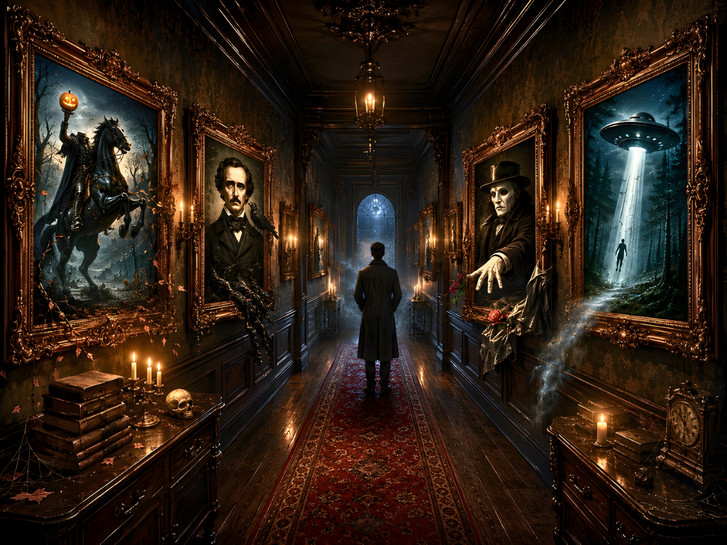
Why We Hang Horror on Our Walls
Every October, millions of people decorate their homes with things that are supposed to frighten them.
They place witches on porches, hang ghosts from trees, display skeletons in gardens, and fill their homes with images of monsters, haunted houses, and creatures from folklore. For a few weeks each year, things that would normally be considered unsettling become welcome guests.
Yet Halloween has always been about more than fear.
If it were only about being scared, we would quickly move on after the surprise was gone. Instead, many of us return to the same stories, characters, and legends year after year. We watch the same films, revisit the same books, and remember the same moments that first captured our imagination.
What keeps drawing us back is not fear itself.
It is the feeling attached to it.
For some, it is the memory of a favorite Halloween night from childhood. For others, it is the excitement of walking through a haunted attraction with friends or discovering a classic horror film for the first time. Sometimes it is a story that stayed with us long after we finished reading it. Sometimes it is a character that became larger than the story from which it came.
The Headless Horseman. Dracula. Edgar Allan Poe. The Phantom.
These figures endure because they become part of our cultural memory. Long after the details of the story fade, the feeling remains.
That may explain why horror fans have always been collectors.
They collect books, masks, props, movie memorabilia, vintage decorations, posters, and artwork. On the surface, these objects appear to be decorations. In reality, they serve a different purpose. They remind us of stories that meant something to us. They reconnect us with memories, seasons, experiences, and emotions that we do not want to lose.
A great piece of horror art is rarely just a picture.
It is a conversation starter.
A memory trigger.
A doorway back into a story.
That idea became increasingly important as technology began changing the way we experience entertainment. Today, stories can be expanded, reimagined, enhanced, and presented in ways that would have seemed impossible only a few years ago. Some people embrace these new tools. Others remain skeptical.
Regardless of where someone stands on the technology itself, the real question remains unchanged: does it deepen the experience?
Does it help us connect with a story in a meaningful way?
Does it allow us to see something familiar through a new lens?
Those questions have inspired much of what we create.
The goal has never been to produce another poster that simply hangs on a wall. There are already countless posters in the world. Instead, we became fascinated by the idea that a flat image might create the feeling of something more. Could a piece of wall art feel immersive without becoming three-dimensional? Could a frame become part of the storytelling rather than simply containing it? Could a familiar character feel less like an image and more like a presence?
Those questions led to the development of the Dimensional Horror Series.
The gothic frames, dramatic compositions, and layered visual effects are not intended to replace the stories that inspired them. They are designed to celebrate them. Each piece attempts to create a sense of atmosphere that encourages the viewer to linger a little longer, look a little closer, and reconnect with a story they already love.
In many ways, that is what horror has always done best.
It invites us into worlds that do not exist, yet somehow feel familiar.
It gives shape to mystery.
It turns imagination into memory.
And sometimes, a single image hanging on a wall can remind us why we fell in love with those stories in the first place.