
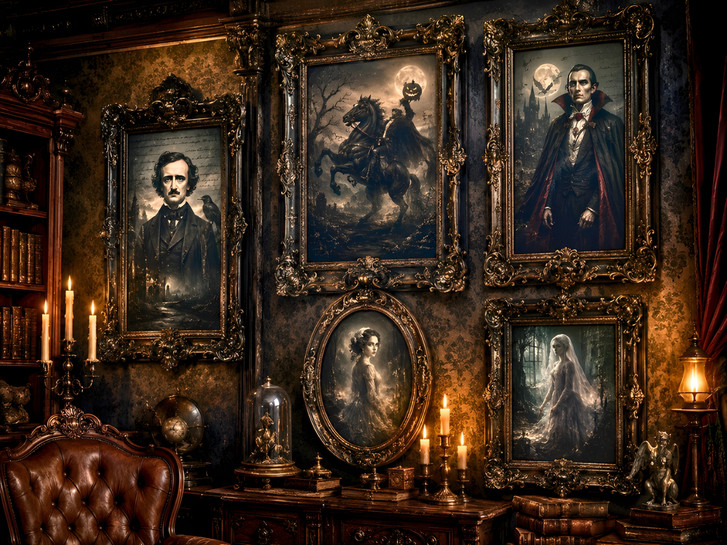
The Art of the Haunted Portrait
Long before horror appeared on movie screens, it lived in paintings, illustrations, and stories.
Victorian homes often displayed formal portraits of family members, historical figures, and people whose stories were meant to be remembered long after they were gone. A portrait was more than decoration. It represented identity, legacy, memory, and presence.
Over time, those same ideas found their way into gothic fiction and horror.
The portrait hanging in a dark hallway became a familiar image. Sometimes it concealed a mystery. Sometimes it watched silently from the shadows. Sometimes it appeared to possess a life of its own.
The concept continues to fascinate us because it sits at the intersection of art and imagination.
A portrait captures a single moment.
A story gives that moment meaning.
When the two are combined, something interesting happens. The viewer begins to imagine what exists beyond the frame.
That idea became one of the inspirations behind the Dimensional Horror Series.
Rather than treating a frame as a border, we began asking a different question:
What if the frame became part of the story?
Traditional posters are designed to present an image. A haunted portrait attempts to create an experience. The frame becomes a window into another world, a forgotten relic from a manor house, a museum piece recovered from a lost collection, or a fragment of folklore preserved through art.
The goal is not realism.
The goal is atmosphere.
The ornate gothic styling found throughout the series is intended to create a sense of history and mystery. Even when the subject is familiar, the presentation encourages the viewer to see it differently.
Edgar Allan Poe becomes more than an author.
The Headless Horseman becomes more than a character.
A vampire becomes more than a monster.
Each becomes part of a larger visual narrative.
That distinction is important because horror has always been about more than what we see.
The most memorable stories leave room for imagination. They invite us to wonder what happened before a scene began and what might happen after it ends.
A successful haunted portrait attempts to do the same thing.
It captures a single moment while suggesting a larger story exists beyond the edges of the frame.
That is why haunted portraits continue to endure as a visual tradition. They create a sense of presence. They encourage curiosity. They transform a familiar image into something that feels personal and alive.
In many ways, that is what great horror has always done.
It invites us to look closer.
And once we do, it becomes difficult to look away.